Q: Is it alright to celebrate the death of an enemy?
Griffin's question, I think, is a difficult one to answer. When the news broke of Osama Bin Laden's assassination at the hands of US Navy Seals, it was met in America with cheers and sighs of relief. For almost ten years, Americans lived in fear of Bin Laden and the Taliban. Now, his death has brought an end to an era which began with the horrible attacks that occurred on 9/11/01. I think it is only natural for Americans to want to celebrate this small victory over terrorism. However, the celebration should not overshadow the reality of America's situation; there are still US forces both in Iraq and Afghanistan. Just because Osama Bin Laden is dead, it does not mean that Al Queda and the Taliban are gone forever.
On a more general basis, the death of anyone, good or evil, should probably not be met with celebration. The loss of life, whether good or bad, needs to be first met with acceptance then with either relief or sadness. In terms of an enemy, the celebration of their death just brings more importance to their life. Giving too much attention to their passing ensures that their legacy will live on. I believe it is better to let the enemy pass in relative silence, in order for the rest of the world to move on without remaining in the past.
Q: Do you think there will be repercussions for Bin Laden's death?
Sunday, May 15, 2011

Singing in the Rain
"Singing in the Rain" is a classic song from the musical Singing in the Rain. Performed by Gene Kelly, it is an iconic number used countless times over and over to express the simple joys in life. However, after watching A Clockwork Orange by Stanley Kubrick, this song has an entirely different connotation. In the movie, A Clockwork Orange,, the main character Alex sings this song while rapping a woman in front of her husband. The contrast between this cheerful song and this horrible act of violence not only makes this scene memorable but also changes the audience's perception of the song. I can no longer listen to "Singing in the Rain" without feeling slightly sick and disgusted.
This experience with the song parallels Alex's situation in the movie A Clockwork Orange where he learns to become nauseous at the sound of Beethoven's Ninth Symphony. In therapy, Alex is forced to watch horrible scenes of violence all while listening to Beethoven. After his therapy, he becomes conditioned to associate Beethoven with violence, just as I associate "Singing in the Rain" with the rape scene in the movie.
Q: Have you ever had an experience like mine, where a song reminds you of something else?
A Clockwork Orange and Existentialism
Note: Read Standford Encyclopedia of Philosophy:Existentialism and A Clockwork Orange fror more information before reading this post.
For the first time, not so long ago, I read The Clockwork Orange by Anthony Burgess. I had orginally entended to use it for my book review, but somehow I decided on Island by Aldous Huxley instead. Not wanting my effort to go to waste, although reading a novel such as A Clockwork Orange could never be constituted as a waste, I thought I would write about it on my blog. Then in class, Israel presented his book report on The Stranger, and all I could think about was existentialism and how it related to A Clockwork Orange.
A Clockwork Orange is based on existentialistic theory. The main character, Alex, commits crimes for no other reason then for the thrills. He is a lunatic who only enjoys life when he is destroying the lives of others. Unlike most psychopaths, Alex did not grow up in troubling circumstances nor did he have a lifechanging experience whcih made him become such a monster. Instead, the only reason for his cruelty comes from the rush of excitement he receives when he is hurting other human beings.
For Alex, nothing matters in life except his constant need to get a "fix" of violence. He has plenty of opportunities to change his way of thinking and reform his actions, but instead, at the end of the novel, he remains the same individual.
The question raised in the novel is whether society or Alex himself is to blame for his actions. Alex has pulled away from society and rejected its norms. Yet, society still tries to help Alex and turn him into a model citizen. As a consequence, however, society ends up making more monsters like Alex. In the end, society has to stop treating Alex and allow him to regress to his former self in order for the rest of society to remain sane.
Q: What is Anthony Burgess saying about societial reform in A Clockwork Orange?
Sunday, May 8, 2011
Fantasia 1940: Night on Bald Mountain and Ave Maria
Fantasia 1940 is for me one of the greatest movies of all time. Below, I have uploaded my favorite part in the movie in which Modest Mussorgsky's Night on Bald Mountain is played against Franz Schubert's Ave Maria. Visually and muscially, the entire piece is breathtaking.
Modernism and Picasso: A Look at Guernica
One of my favorite Picasso paintings is Guernica. This mural portrays the bombing of Guernica by German Italian warplanes on April 26, 1937 during the Spanish Civil War. Although the painting is very abstract, Guernica convincinly portrays the horrors of war. This painting is in the style of Cubism where people and things are painted in abstracted shapes such as circles, squares, and triangles. This adds to the ugliness and disarray of the mural, symbolically representing the chaos and turmoil of the war.
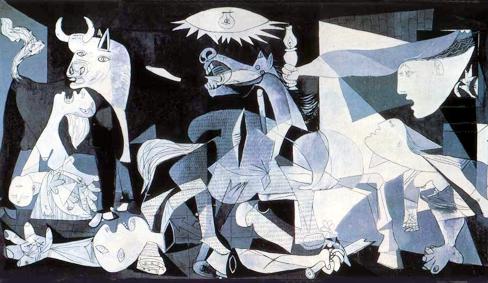
For more information about Guernica click here Guernica
For more information about Cubism click here cubism
Q: Who is your favorite artist? Do you have a favorite painting from them? Does the painting have any social or political implications?
In response to Julia's question
"Do you like modern art? If you do, what do you like about it?"-Julia Ashton
To be honest, I am not a big fan of modern or contemporary art. I have visited MassMOCA a few times now, and I always have a hard time getting into the exhibits. Some of the pieces can be cool, but most of the time, I end up becoming bored and confused after about 20 minutes. While this is only my opinion, I have a hard time calling something art that I use to make in kindergarten class. I understand modern and contemporary art is more intellectual and less emotional than other forms of art, so in that case to understand it, I would probably have to become fluent in the language of modern art. I guess my dislike of modern art stems from my lack of understanding.
Q: Are there any modern pieces of art that you think are more emotional than intellectual in nature?
Stravinsky's The Rite of Spring
The well known experimental psychologist, Steven Pinker, has said that art "should conform to human nature and thus artists should simply give people what they want"(Sanderson 4). He also stated that modern art is "ugly, baffling, and insulting"(Pinker, 2002:416). It seems to me that not only does Pinker have a narrow view of human nature, he also has a narrow view on what constitutes true art.
To prove the inefficiency of Pinker's statement on modern art, one only needs to cite the example of Stravinsky's "The Rite of Spring". Although this orchestral masterpiece is not an example of modern art, it was written around the year 1912, it was considered at its time to be much of what modern art is considered to be now by many critics. As some background information, before Stravinsky wrote "The Rite of Spring" he had found success with the piece "Firebird". This piece, then made into a ballet, had a "fanciful story and gorgeous music in the grand and familiar style of Tchaikovsky"(Gutmann 2001/2002). No one expected Stravinsky to create an orchestral piece that would cause so much commotion as "The Rite of Spring". This piece, as well as the accompanying ballet, told the story of pagans sacrificing a maiden to the gods to help bring about spring. When the ballet was introduced on May 29, 1913, the audience responded in an all out riot. They were shocked not only by the ballet but also by the foreign music they were hearing. Stravinsky pushed the boundaries of his audience and as a result, his audience revolted.
Now almost 100 years after the piece was originally written and performed, "The Rite of Spring" is considered one of the greatest modern pieces of all times. Walt Disney used the score in his masterpiece, Fantasia bringing "The Rite of Spring" to the masses. This goes to show that sometimes, the audience does not know what is best for art, and just because an audience does not react kindly to a piece of art, it does not mean that the art itself is "ugly, baffling, or insulting". Rather, maybe the audience is just not ready or enlightened enough to fully grasp the art.
Below are the pieces, "Firebird" and "The Rite of Spring". These clips were taken from Fantasia and Fantasia 2000. My suggestion is that instead of watching the clips, rather just listen to the music.This is so you can visualize the music for yourself rather than become a slave to Walt Disney's interpretations and miss Stravinsky's original intentions.
Q: What other forms or pieces of art were originally rejected or criticized by the public but are now viewed as "classics"?
Saturday, April 30, 2011
Dude Looks Like a Lady Contest
I know this has nothing to do with torture but I think this is important nevertheless
Last night at Relay for Life, there was a Dude Looks Like a Lady contest where a male member of each relay team dressed up like a women and put on a fashion show to raise money for the cause. Although it was funny and the guys who dressed up looked hilarious, I was hit with the realization that I had never encountered a Girl Looks like a Man contest ever in my life. When men dress up like women, especially in situations where it is meant to be in good fun, such as the Hasty Pudding Theatricals at Harvard, no one seems to have a problem with it. When girls dress up like guys, even in theatrical events, there is a stigma placed on the girl. I do not want to sound like a feminist but for the longest time, women were condemned for wearing pants. My idol, Katherine Hepburn, was often criticized for dressing in stereotypical men's attire such as suits and blazers. Truth be told, it is a lot funnier when guys dress like girls then the other way around, so I figure that is why those kinds of contests are more popular. I never really thought of it before, and it only came to my attention last night, seeing as I had tons of time to be with my thoughts.
Q: Why do you think Girl Looks Like a Man contests have never materialized?
How Relay for Life Had Me Thinking About Torture
From 6pm on April 29 to 8am on April 30, I participated in Bershire County All College Relay for Life. This event raised money for the American Cancer Society to help fight cancer. For roughly twelve hours, I and many others walked in circles around the quad while a DJ blasted music at earsplitting levels. Now in all fairness, I had a really great time. I walked with my friends and we played games and danced to music. The food was good and everyone was in good spirits. Yet, as I began to start what seemed as my five hundredth lap around the quad and my knees and hips began to give out, I started to think of how easily this event could be used as torture. Even though I was having an awesome time, the lack of sleep and the physical toll on my body was significant; to make things simple let me say I walked for 10 hours at a clip of 3 miles an hour. In all, I walked roughly 30 miles in a fourteen hour period. If I was a prisoner of war and I was made to walk all night around in a circle with strange music blasting from loudspeakers without anyone to talk to, I would definitely go crazy. The pain that I would be feeling physically combined with the mental state created by this environment would be unbearable.
Q: Have you ever been in a position where your body and mind was pushed to their limits?
Q: Have you ever been in a position where your body and mind was pushed to their limits?
In response to Jenny Beer's question
Q: Is talking about and/or seeing torture difficult for you? Is it too extreme like me or are you interested as well as disturbed?
The sad reality of American today is that torture has become a norm in our society. As a result, I have become somewhat immune to the entire topic of torture, especially today's form of it. Somehow it is a lot easier to discuss waterboarding then forms of medieval torture such as impalement and coffin torture (If anyone is interested in medieval torture here's a cool website that discusses the different types of torture devices used in the Middle Ages: Torture).
I can remember when I first saw the photos taken at Abu Ghraib. I felt a sense of disconnect between the images and what I should have been feeling. In my head, I knew what I was seeing was appalling and heinous but I felt absolutely nothing. On the other end, when I read 1984 and Winston was tortured in room 101, I had a hard time stomaching through the chapter. I guess that some of the reason I felt more for Winston was that I had formed a connection with him through reading the novel, and I instinctively wanted him to beat Big Brother. The victims of Abu Ghraib on the other hand were nameless faceless individuals. I had no emotional investment in them. Later on, when I watched a documentary of Abu Ghraib during my senior year in high school, I cried when I saw the same photos I had seen six years prior. This was because the documentary had given the nameless faceless individuals identities; the documentary portrayed them as human beings.
Q: Why do you think so many Americans still support the use of torture, especially after incidents such as Abu Ghraib have been made public?
Waterboarding
I was shifting through torture articles online when I came across a piece in Vanity Fair magazine called "Believe Me, It's Torture". The article recounted how one of the magazine's writers, Christopher Hitchens, subjected himself to waterboarding to experience firsthand what it would be like to undergo the process. At the time this piece was written in 2008 and essentially all throughout the Bush Administration, waterboarding was a highly debated subject. The main dispute over waterboarding was whether it was actually a form of torture. Waterboarding, for those who are unfamiliar with the term, is a process in which an individual is strapped to a wood board with a towel across his mouth, which is continuously soaked with water so the individual feels as though he is slowly drowning. For most people, the description of waterboarding alone would convince them that it is a form of torture, but just to drive the point home, Hitchens agreeded to undergo waterboarding and have his experience recorded for the world to see.
There were two things that really struck me with this article. The first was that Hitchens exposed a little known fact that waterboarding was actually a training method used by Americans to train other Americans to resist enemy interrogation. The United States military came up with waterboarding as a simulated form of torture that terrorist might use on Americans. The irony of this whole situation is not lost on me. How could American interrogators waterboard suspected terrorists knowing firsthand what it was like to be in the terrorists' shoes? Obviously I am not a highly trained military official but I know if I underwent a horrendous ordeal such as waterboarding, I certainly would not want anyone to go through what I went through.
There were two things that really struck me with this article. The first was that Hitchens exposed a little known fact that waterboarding was actually a training method used by Americans to train other Americans to resist enemy interrogation. The United States military came up with waterboarding as a simulated form of torture that terrorist might use on Americans. The irony of this whole situation is not lost on me. How could American interrogators waterboard suspected terrorists knowing firsthand what it was like to be in the terrorists' shoes? Obviously I am not a highly trained military official but I know if I underwent a horrendous ordeal such as waterboarding, I certainly would not want anyone to go through what I went through.
The other point that stood out for me was when Hitchens briefly mentioned how waterboarding did not simulate a sense of being drowned but actually drowned the individual being waterboarded. Simulation and actuality are two completely different things. Going on a simulated amusement ride at a park, say a ride that simulates going into outer space, is not the same thing as actually going into outer space. There are a lot less risks in going on a simulated ride then in experiencing the process firsthand. Simulated rides or experiences can bring about sensations of undergoing a real life situation and thus produce similar reactions as if the situation were real, such as a person feeling afraid while watching a horror movie; however, the person in the theater watching the horror movie is in no real danger. If waterboarding goes beyond simulation, which in itself can cause severe physical and psychological problems and is morally objectible, then waterboarding needs to be eradicated.
Here is the video of Christopher Hitchens being waterboarded. Warning: This video contain some disturbing content. Here's also a link to the article: Waterboarding Article
Tuesday, April 19, 2011
In Response to Shannon
Growing up, my parents utilized two different types of parenting styles, authoritarian and authoritative. Their authoritarian style of parenting lasting from the time I could talk up until I entered middle school. As a young child, my life was laid out for me by my parents. I was told what to wear, who to be friends with, how to act, and what activities I was allowed to be involved in. There were many rules in my house that my brother and I had to follow. For instance, neither my brother nor I could play with friends after school. We both were made to go straight home and complete our homework. Then, if we had time, we were permitted to play in our backyard, as long as we had helped prepare for dinner. There were also rules about swearing and talking back to our parents; I can remember being grounded for entire summers because I had sworn in my parents' presence. For the longest time, I grew up in a very controlled, strict household.
As I grew older, my parents grew relaxed in their parenting style. It became less what they wanted for me and more what I wanted for myself. I could choose the activities I wanted to be involved with; for instance, I was able to give up Girl Scouts and start running track. My parents still had high expectations when it came to school and my grades. I continued to get grounded for bad marks (in my house anything lower than a B was horrible) and I still could not go out after school. However, I started to have more freedom in the way I dressed, and I was able to choose the friends I wanted to hang out with. This greater sense of freedom made me feel more in control, and I was less likely to act out.
Without a doubt, I would definitely be a different person if my parents had chosen to bring me up with a different parenting style. I think I would be more outgoing if my parents had been less authoritarian and more authoritative. As I am now, I am too shy and less assertive. I tend to accredit this to my lack of say in my house as a child. I also know my relationship with schools and my grades would not be the same growing up in a different household. Still to this day, I am always afraid to get back my grades because I am worried about how well I did and if my parents would approve. On the other hand, my parents did instill in me some valuable traits that I could not live without. My parents taught me to be well mannered and polite. They pushed me to go beyond my limits and be the best at whatever I did. Sometimes, they might have pushed me too far, but no parent is perfect.
Q: Do you agree with how you were raised? What parenting style do you think produes the best results?
Response to "Patriotic Millionaires"
First I have to say, I think it is really sad that in this day in age, US citizens have to petition the government in order for it to do its job. Citizens, in this case millionaires, should not have to tell the government that it needs to tax the rich in order to stabilize the economy. Furthermore, I find it disturbing that the millionaires are calling themselves patriots. Is it because they are offering to give up some of their income to taxes, which they should be doing in the first place? Or is it because they want to save the country which allows them to make so much money? The millionaires are not patriots. They have just as much stake in this country as the average citizen.
Q: How do you think Congress will act to these sorts of petitions?
Q: How do you think Congress will act to these sorts of petitions?
Saturday, April 16, 2011
In response to Julia's question "Do you find people more attractive because of their looks or their personalities upon first impression? Most people make an initial impression of someone based on their looks. Do you agree or disagree with this? Why are looks, and not other qualities such as intelligence and compassion, most highly valued in our society?"
Although it is sad to say, for first impressions, looks tend to be more important than personality. Society is obsessed with appearances. Case in point my favorite series"What Not to Wear". For those not familiar with the show, two style experts spend an entire week fixing a fashion train wreck. During almost every episode, the person who is having their wardrobe overhauled says something to the extent that appearances should not matter. The style experts quickly get the subject to realize that in order to play the part one must look the part. A lot of the people on the show are up and coming professionals, and their attire is preventing them from being taking seriously. They soon learn that although it might be superficial, appearances play an important part in society.
While looks are important, they can only take people so far. People also need vibrant personalities to take themselves to the next level. I know of people who on first impression were extremely attractive, but the more I got to know them and recognize their personalities, the less time I wanted to hang out with them. Beautiful people can turn ugly if their beauty is only skin deep.
Q: What is your opinion of plastic surgery? Is it a result of society's obsession with youth and beauty or is it more personal?
How the US Government and Big Corporations Go Hand in Hand
Recently, I was watching the Daily Show online and I came across this clip titled "I Give Up-Pay Anything". Underneath the video, there were tags that read GE, wealth, taxes so I thought that maybe it might have something to do with our conversation in class about CEO compensation and corporate greed. As I watched, I discovered that President Obama recently named General Electric CEO Jeff Immelt as the chair to The Council on Jobs and Competitiveness. This came after President Obama saying that the government needed to stop large corporations from receiving tax breaks and sending jobs overseas. The situation is ironic because GE made 14.2 billion dollars in worldwide profits last year while paying no corporate taxes. In fact,it actually made 3.2 billion dollars in government compensation. Large corporations are supposed to be taxed 35%, but statics have shown that 2/3 of the major businesses in the United States pay no corporate taxes. To add more insult to injury, in the past decade, GE has outsourced 1/5 of its jobs to other countries. From this example alone, it is no wonder why the government cannot balance the budget.
Here's the link to watch the video: http://www.thedailyshow.com/collection/380202/best-of-corporate-greed/379045
Q: Is the government just a puppet of large corporations?
Here's the link to watch the video: http://www.thedailyshow.com/collection/380202/best-of-corporate-greed/379045
Q: Is the government just a puppet of large corporations?
Saturday, April 9, 2011
In response to Jenny Beer's question, "From an adult standpoint, do you think that "Facebook is evil" or does it serve a beneficial purpose in society?
On the whole, I hate Facebook and I think it is evil. That being said, I have a Facebook and I check it multiple times a day. I try to tell myself the only reason I have it is to keep in touch with people and stay in the "loop", but really it is a tool which I use to value myself against others. Everytime I post a status, I try to think of how many responses I'll get. My self esteem is tied directly to people's responses or lack of responses. I get a knot in my stomach, anticipating if and when one of my "friends" will comment. Facebook is destroying my sense of self, but I cannot seem to live without it. I crave it, and I have a hard time refraining from it. I feel like I will miss something important without it.
Q: Why has Facebook become so important in today's society?
Q: Why has Facebook become so important in today's society?
Response to Julia Ashton's question "Have you ever been labeled? Did you agree with this label, or did you rebel against it?"
All through high school, I was labeled the "shy, smart" kid. I deserved this label in many respects and learned to embraced it because it essentially described who I was at that time. On the day to day, I was the girl who didn't really talk unless I was answering a question, and I was always on the high honor roll. Normally, people rarely talked to me unless to ask me questions about homework or class, which I most likely had the answers to. I was that "shy, smart" girl people labeled me as.
Now that I am out of high school, I am trying to shed that label. I find it less appealing to be what people expect of me. It is more exciting, in my opinion, to keep one's mind open, instead of placing everyone in a neat orderly box.
Q: Are there less labels in college?
Now that I am out of high school, I am trying to shed that label. I find it less appealing to be what people expect of me. It is more exciting, in my opinion, to keep one's mind open, instead of placing everyone in a neat orderly box.
Q: Are there less labels in college?
Why Public Schools Should Not Be Privatized
After listening to Joseph Stiglitz's interview with Democracy Now, I was surprised, but rather sadden, to hear that one of the results of the top 1% receiving more and more of the US's wealth was the elimination of public schools and the increase of private education. With the economy still trying to recover from the financial crisis, less federal money is being pumped into the public education system. Public schools are constantly taking disastrous hits to their already insignificant budgets. With less resources, the public schools cannot compete with their private counterparts, and as a result, more parents are opting to send their children to private schools. There are many problems with this recent turn to privatizing public schools, which are laid out in the article "Confronting the Challenge of Privatization in Public Education" written by Dr. Pedro Noguera of the University of California, Berkley. Using California schools as his basis, he explains why privatizing public schools in the US would lead to the country in the wrong direction.
Dr. Noguera argues that despite the weaknesses of the public schools, they still are the best and often only sources of mobility to working class people and the poor. Unlike private schools which can deny students access, public schools allow the underprivileged a change to have a level playing field with other students. Allowing public schools to be privatized would mean an increased amount of segregation across the country in the educational system. In a way, private schools result in less equality.
Another problem Dr. Noguera has with this new trend is that private schools are not held to the same standards as public schools. Public schools have certain criteria they have to adhere to, provided by them by the government. All public schools must follow these guidelines; however, private schools can make their own curriculum. In many cases, the private school curriculum's are religious based or the school year is lessened or lengthened. This puts all the students across the country at different levels of education, beyond what naturally occurs.
Beyond what Dr. Noguera lists as his reasons for not privatizing public education, I personally believe public schools should not be privatized simply on the grounds that the United States was the first industrialized nation to establish public schools, and in doing so, it allowed this country to become what it is today. Privatizing public schools would limit opportunities only to a select group of people, which goes against the principles this country was founded on. Public schools are, as Dr. Noguera says "an important natural resource". It is my opinion that the country should not get rid of them but rather reform them.
Q: As an MCLA student, what have you noticed are some disadvantages and advantages to attending a state college?
Dr. Noguera's article: http://www.inmotionmagazine.com/pnpriv1.html
Saturday, April 2, 2011
In response to Julia Ashton's question "Why is it today that there are so many less people who are willing to physically fight for America than in the past?"
I think people are less willing to fight for America nowadays then in the past has to do with a couple of factors. First, media has drastically changed the way we view the world. Back during the Revolutionary War and even up to WWII, public opposition of war was swept under the rug. There were no 24 hour news shows uncovering facts about the presidential administration. Citizens were more likely to trust in their leaders because they had less ways of proving otherwise. Now with the Internet, sites like Wiki leaks can expose military and government cover-ups with just the click of a mouse. It is harder now for the government to fool American citizens into believing what they want them to believe.
Also during older wars, Americans had more to fight for. While modern-day America often wages war over oil and ideals, during the Revolutionary War, soldiers were actually fighting for their country. If common people refuse to take up arms, there would be no United States of America. There was more on the lines for the early Americans then todays's citizens. The same goes with American soldiers fighting in WWII. Those who enlisted saw the attack on Pearl Harbor as the Japanese way of trying to destroy the US. WWII was actually legit, as opposed to recent wars like Vietnam and the Iraq War.
Q: Have colleges changed the way the younger generations view war?
Support the Troops
Up until fairly recently, about 2 years ago, I never really gave much thought to the phrase "Support the Troops". However, now that my brother is in the US Army and has already been deployed to Afghanistan ans is waiting to go to Libya, that phrase has a lot more meaning. It is has, in many respects, become a way of life for me and my family. Both of my parents have bumper stickers on their cars with the slogan and both proudly tell everyone they meet that their son is in the Army ; on our door, we have a yellow ribbon symbolizing family in the armed forces (I also have multiple cousins who are currently stationed in Iraq and Afghanistan). My family has essentially transformed into a military family. While different members of the family have different opinions over the legitimacy of the war itself, everyone is behind the military. In some ways, I would see it as wrong to be otherwise. I personally believe that making the ultimate sacrifice for one's country is the most heroic and patriotic thing one can do. As a soldier, my brother is more patriotic, in my opinion, than myself and most people I know. He is what I strive to be. Although the reasons for being over in the Middle East are ungrounded, they have no barring on how I view the soldiers who are fighting for their country. These individuals are to be admired, as long as they are living up to certain morals instilled in them by the military.
I am obviously writing this in response to the class discussion about patriotism. I agree that those who disagree with the war and who speak out against it are also patriots. I also agree that those who ardantly support the war without adequate reason for doing so are not true patriots. But ultimately, I think that those risks their lives on a daily basis to serve their country, whether it be soldiers, firemen, policemen or often demonstrators advocating unpopular stances on social issues, are the most patriotic.
Q: How do you feel about the draft?
Subscribe to:
Posts (Atom)